If you’ve ever used Bannerbear to automatically generate images via API, you’ve probably reached the same point many technical teams do: the product works well, but costs quickly add up as operations scale.
Bannerbear’s entry plan costs $49/month for 1,000 image credits. For those generating course completion certificates, campaign-specific personalized cards, or automated marketing images at volume, that limit disappears fast. The $149/month (3,500 images) or $379/month (10,000 images) plans start to make less sense once you discover there’s an alternative with a more straightforward value proposition.
It’s in this context that product and engineering teams are evaluating Vecsy’s API.
What Bannerbear Does Well — and Where It Falls Short
Bannerbear is a solid tool for automated image generation via API. The concept is clear: you create a visual template, define variables (text, image, color), and call the API whenever you need to generate a personalized version. It works for certificates, thumbnails, social media posts, user cards, and other formats.
The issue isn’t functionality. It’s about the equation — and the experience.
When you do the math for real volume — an education platform issuing certificates to 5,000 students per month, a CRM sending personalized cards by email, an event platform generating credentials automatically — Bannerbear shifts from a support tool to a significant fixed cost. And as operations scale, the build vs. buy logic starts to change.
Besides cost, another frequent point in evaluations is Bannerbear’s editor steep learning curve. Creating and adjusting templates takes time and familiarity with the tool — meaning the technical team’s dependency to keep templates active is higher than expected.
What Vecsy’s API Solves
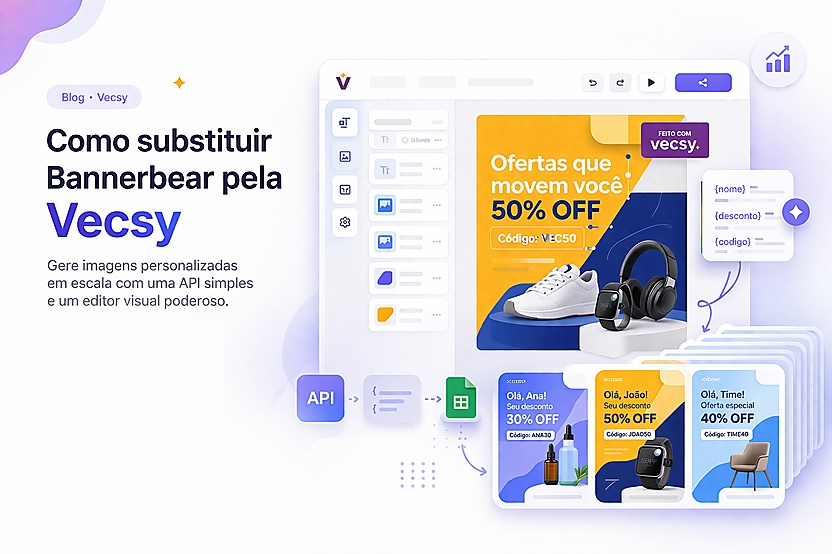
Vecsy’s API was built for the same core use case: programmatically generating personalized images at scale from templates with defined visual identity.
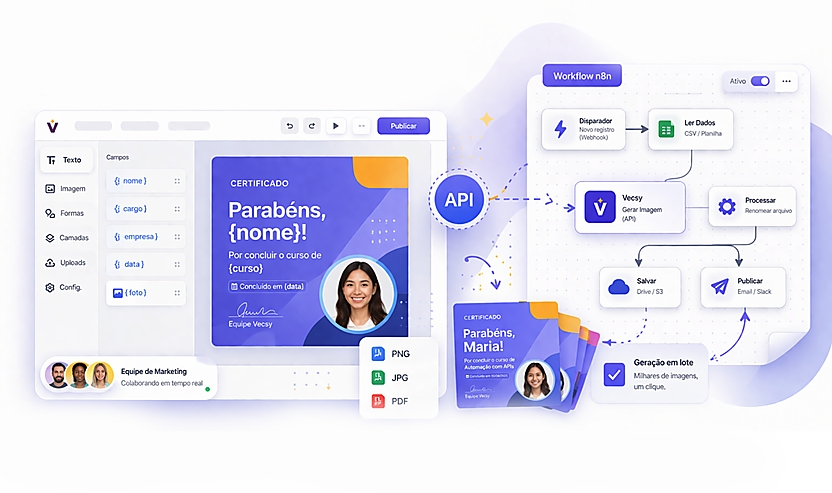
The integration logic is familiar to those who know Bannerbear: you create your template in Vecsy, define dynamic fields (name, photo, user data, date), and call the API whenever you need to generate a new version. The response is a PNG image — or PDF on the PRO plan — ready to be sent, displayed, or stored.
A practical differentiator: Vecsy’s editor was designed to be simple and straightforward. Marketing teams can create and adjust templates without relying on engineering — reducing operational bottlenecks and speeding up the visual content update cycle.
Use cases that fit perfectly:
- Course platforms that automatically issue certificates upon completion
- Registration sites generating personalized cards at signup
- CRMs including custom images in email or WhatsApp campaigns
- Companies with multiple locations needing standardized visual content at scale
- Events sending visual credentials to speakers and participants before the date
For any of these scenarios, integration is straightforward via REST API with any stack — Node, Python, PHP, Ruby, whatever you already use.
What to Consider Before Migrating
Not every API migration is worth the effort. Before switching from Bannerbear to Vecsy, it’s worth answering a few questions:
Are you generating more than 1,000 images per month? If yes, Bannerbear’s cost likely starts to hurt. If your volume is still low, Bannerbear’s free plan (30 images) or entry tier might remain suitable for a while.
Is your use case for personalized static images — or do you need video? Vecsy focuses on images (PNG and PDF). If your pipeline includes automated video generation, that’s an important comparison point.
How complex is your template personalization? Vecsy supports templates with dynamic text, image, and other fields, with a simple, user-friendly visual editor. If your operation requires very complex visual composition logic (multiple layered overlays with advanced conditional rules), it’s worth testing the tool before committing to integration.
How It Works in Practice: The Integration Flow
For a developer, integrating with Vecsy’s API follows the logic of any modern REST API:
- Create the template on Vecsy’s platform with defined dynamic fields
- Obtain your API key
- Make the call passing field values (name, photo, user data)
- Receive the generated image URL or the binary directly, depending on configuration
The integration model is stateless and event-driven — each API call generates an independent image, facilitating integration with webhooks and asynchronous automation flows.
Don’t Switch Just for Price. Switch for Fit
The most common reason to consider an alternative to Bannerbear is cost. But the strongest reason to fully migrate is fit: the tool solves your use case with less friction and lower operational cost as volume grows.
Vecsy’s API isn’t here to compete with Bannerbear on paper. It exists to be a concrete option for teams generating personalized images at scale who want a tool with more accessible pricing and a clear focus on the use case.
If your generation volume is growing and Bannerbear’s cost is starting to weigh on your budget, it’s worth evaluating.
Want to explore Vecsy’s API? Talk to the team to understand how to integrate it with your stack and see if it makes sense for your operation volume. Request API access →