Discover how user-generated content from clients and partners boosts trust in your brand, lowers acquisition costs, and turns your community into a growth engine — with visual consistency and zero friction.
If you work in B2B marketing, you already know that selling to businesses is different from selling to end consumers. The buying cycle is longer, the decision-making committee is larger, and trust needs to be built much more carefully. This is where B2B UGC comes into play — and for a simple reason: no message from your own brand will carry the same weight as the voice of a real customer.
UGC (User-Generated Content) is not new in B2C. But in the B2B context, it is still underutilized — which creates a huge opportunity for those who decide to explore this strategy before their competitors.
In this post, you’ll learn what B2B UGC is, why it works better than traditional marketing content, the most effective formats, and how to use Vecsy to activate your community with visual consistency and zero friction.
B2B UGC is any content created and shared by customers, partners, employees, or members of a professional community that mentions or promotes your brand — without being produced directly by your marketing team.
It could be a LinkedIn post from a customer explaining how your product solved a real problem, a customized card shared by an event participant, a video testimonial from a partner, or a digital badge displayed by a certified student.
What differentiates B2B UGC from spontaneously generated content is the activation intent: brands that grow with UGC don’t passively wait for customers to create content. They create the conditions for it to happen — with templates, incentives, and minimal friction.
In B2B, purchase decisions are rarely made by just one person. There’s a committee: finance, operations, legal, leadership. Each person in this committee seeks social validation before approving any investment.
According to Edelman data, 81% of B2B buyers consider trust a decisive factor when choosing a supplier. And trust doesn’t come from ads — it comes from evidence. From social proof. From seeing other companies using and recommending that solution.
That’s exactly what UGC delivers: the voice of those who have already bought, used, and have results to show.
Imagine each satisfied customer posts a customized card on LinkedIn showing the results they achieved using your product. This content reaches your customer’s network — which, in a B2B context, likely includes directors, managers, and founders in the same sector you want to target.
This reach costs no media budget. It doesn’t depend on ad spend. And it carries a level of credibility no advertisement can match.
There’s a myth that B2B buyers are purely rational. In reality, they are humans making high-risk decisions. And humans, when in doubt, look at what others have done.
A post from a market peer saying "we used this solution and it worked" has far more influence than any institutional campaign.
When a customer completes training, hits a goal, or goes through a program at your company, giving them a customized card to share is a natural and powerful way to generate UGC.
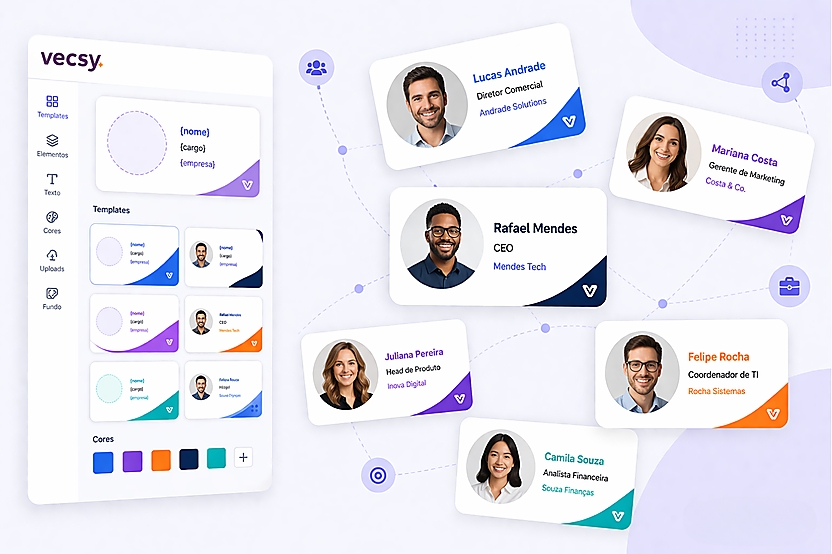
This card appears on LinkedIn with the customer’s name and face — along with your brand’s name. It’s visual social proof, organically distributed by your customer’s own network.
📊 DIO Case: Digital Innovation One uses this model for every certificate issued. The result? Over 4,000 shares per campaign, with an estimated reach of 1 million people.
B2B events — conferences, summits, webinars, acceleration programs — have huge UGC potential. When a participant confirms attendance and receives a customized card with their name and the event logo to share on social media, they’re making a public statement of belonging.
This builds anticipation, increases the event’s perceived authority, and expands organic reach even before the event takes place. See how to use this strategy in the post about "I’m Attending" artwork for events → [internal link]
Strategic partnerships, ambassador programs, and communities of practice are common in B2B. Giving members a digital badge they can display on LinkedIn is a way to activate pride of belonging — and turn that into real visibility for the brand.
Quantify a customer’s result in a visual card and give it to them to publish. "We increased conversion rates by 40% in 3 months" is much more impactful as a customized card with your brand identity than as a PDF case study that no one will read.
The main barrier to UGC in B2B isn’t lack of customer interest — it’s friction. When you ask a customer to create a post, they need to: open Canva, find the right template, personalize it with their data, export, and publish. That’s several steps for something they’ll do for free, on their own.
The result? Most give up before they start.
Vecsy’s approach is to reverse this process: the customer accesses a link, enters (or confirms) their data, and within seconds has a customized card ready to share — with your brand’s visual identity, with no chance of error.
Less friction = more sharing. The fewer steps the user has to take, the higher the participation rate in the campaign.
B2B UGC isn’t a passing trend; it’s one of the most underutilized growth strategies in Brazilian business marketing. When you turn customers, partners, and participants into visual ambassadors for your brand, you gain organic reach, credibility, and structurally reduce acquisition costs.
And the good news is you don’t need a dedicated design team for this. With Vecsy, any company can activate Branded UGC campaigns with visual consistency and zero friction for the user.